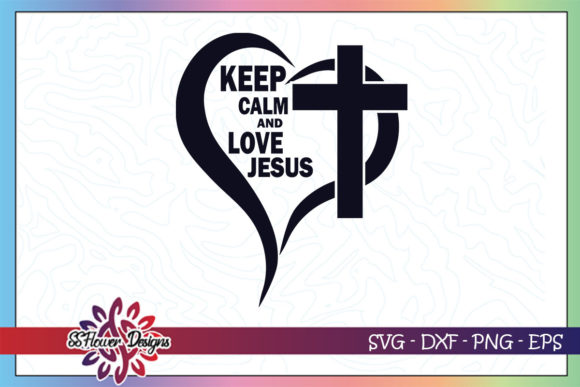
Keep Calm and Love Jesus Cross: Integrating Faith and Focus into Your Daily Workflow
In a landscape of constant notifications, tight deadlines, and competing priorities, maintaining a steady mind is a practical skill. The Keep Calm and Love Jesus Cross is more than a decorative phrase; it is a visual and mental anchor that bridges faith-based resilience with everyday productivity. Whether displayed on a desk, used as a phone wallpaper, or kept as a quiet mental prompt, this symbol helps you return to a centered state before, during, and after any task. Its strength lies not in complexity but in instant recognition—the familiar "Keep Calm" message fused with the cross creates a dual reminder: breathe, and trust a larger purpose.
For professionals, creators, and entrepreneurs, the cross serves as a practical tool rather than a passive decoration. It fits into workflows that demand clarity under pressure. Instead of treating it as mere inspiration, think of it as a reset button you can press in any moment of friction. The following sections explore how to use this simple sign as part of a real, repeatable process across various roles and routines.
Where the Keep Calm and Love Jesus Cross Fits in a Broader Process
Every project, decision, or creative cycle includes phases of tension. The Keep Calm and Love Jesus Cross is most useful at the points where anxiety or distraction typically arise. It can be integrated before you begin a task (preparation), during execution (maintaining focus), or after completion (reflection and recovery). Because it is a static symbol, its power comes from how you choose to engage with it. Treat it as a cue that triggers a specific mental or physical action.
Before a Project: Setting Intention and Reducing Overwhelm
When starting a complex task—writing a report, launching a campaign, or planning a curriculum—the initial rush of thoughts can derail efficiency. Place the Keep Calm and Love Jesus Cross where you will see it before you open your laptop or pick up a pen. Let it signal a brief pause: two deep breaths and a short prayer or affirmation. This step takes thirty seconds but recalibrates your nervous system. You shift from reactive mode to intentional action. Over time, the cross becomes a trigger for this pre-work ritual, creating a consistent entry point into focused work.
During a Task: A Non-Disruptive Anchor for Stressful Moments
Mid-task interruptions or unexpected obstacles often provoke frustration. Instead of letting irritation compound, glance at the cross. Use it as a permission slip to take a micro-break of five to ten seconds. Close your eyes, touch the cross if it is a physical object, and silently repeat “Keep calm and love Jesus.” This interrupts the stress loop without leaving your work environment. For entrepreneurs handling a difficult client call or freelancers facing a revision request, this tiny ritual preserves emotional stability and decision quality.
After Completion: Closing the Loop with Gratitude
Finishing a task, especially a demanding one, can leave you drained or already worrying about next steps. The cross can mark a closure moment. After hitting “send” on a proposal or finishing a lecture, deliberately look at the cross and take a breath that acknowledges effort. This practice builds a habit of completion and gratitude, reinforcing resilience over time. It also creates a clear separation between one piece of work and the next, which is crucial for long-term consistency.
Interacting with Other Tools and Methods
The Keep Calm and Love Jesus Cross is not intended to replace calendars, to-do lists, or time-blocking systems. Instead, it enhances them by addressing the emotional and spiritual layer that those tools ignore. Pair it with:
- Mindfulness apps: Use the cross as a visual complement to guided breathing exercises. When you finish a meditation session, keep the cross in your line of sight as a reminder to carry that calm into your next activity.
- Journaling: Place the cross next to your journal. Before writing, glance at it to center your thoughts. This simple step makes your entry more intentional and less reactive.
- Task management boards: At the top of your Kanban board or digital planner, add an image of the cross. When you move a card from “In Progress” to “Done,” pause a moment to acknowledge the small win.
- Physical workspace layout: Mount the cross at eye level near your main work area. Position it so that when you look up from your screen, it is the first object you see. This strategic placement turns it into an ambient anchor.
Practical Implementation Tips by Role
Different professionals will find different points of integration. Below are role-specific examples that show how the cross becomes part of a real workflow, not a decorative afterthought.
For Bloggers and Content Creators
Writer’s block or performance anxiety often arises from over-focusing on outcomes. Before you start drafting, set the cross beside your keyboard. Let it remind you that your work is an act of love, not just performance. When you hit a rough passage, touch the cross and rewrite the sentence without judgment. This method reduces the pressure of perfection and increases output quality over time. After publishing, use the cross as a signal to step away from analytics and rest.
For Entrepreneurs and Small Business Owners
Decision fatigue is a constant risk. Keep a small cross in your pocket or on your desk. Before making a hiring decision, approving a budget, or responding to a difficult email, take the cross in your hand. Let it stand for the values that guide your business—calm, love, faith. This simple tactile check can prevent hasty choices and foster a leadership style that prioritizes clarity over reactivity.
For Educators and Trainers
Classroom or training environments can become chaotic. Place the cross near your teaching station, but in a way that is subtle. When you feel a lesson going off track, glance at it as a private reminder to keep your tone steady. You can also use the phrase “Keep calm and love Jesus” as a personal mantra before walking into a meeting or parent conference. The cross grounds you so that you model composure for your students or participants.
For Freelancers and Remote Workers
Working alone lacks the natural social anchors of an office. The cross can become a boundary marker. Place it next to your laptop at the start of your work session. When you see it, you know you are in work mode. At the end of your shift, move it to a different location—signaling that work is done and it is time to rest. This physical ritual supports the psychological separation between professional and personal life.
Factors That Affect Long-Term Use
To make the Keep Calm and Love Jesus Cross a lasting part of your routine, consider the following practical factors.
Preparation and Placement
Choose a form factor that suits your environment. A small desktop plaque works for a home office; a pendant can be worn throughout the day; a digital image serves as a phone lock screen. The key is visibility and accessibility. If you cannot see it in moments of stress, it cannot serve its function. Test multiple positions until you find one where your gaze naturally falls when you look up from your main task.
Compatibility with Existing Systems
The cross does not require you to change your current productivity method. It layers onto any approach—GTD, Pomodoro, time blocking, Kanban—by adding a calm trigger. During a Pomodoro break, for instance, you might look at the cross while stretching. In GTD, you can use the cross during the weekly review to approach your task list with a relaxed mindset.
Usability and Consistency
The less friction, the better. If you have to search for the cross, you will forget to use it. Place it in a fixed spot and make the associated action extremely short (one breath, one glance). Over time, the cross will become a conditioned stimulus for calm. Consistency is more important than duration. Using it three times a day for five seconds is more effective than a weekly twenty-minute session.
Organization and Quality Control
If you own a physical cross, keep it clean and uncluttered. Do not stack papers or accessories on top of it. Its presence should be clear and intentional. For digital versions, set a recurring alarm at the start of your work blocks that shows the image as a notification. This ensures you do not silently ignore it.
Efficiency in Distraction Management
Distractions are the main threat to workflow continuity. The cross does not prevent distractions, but it shortens your recovery time. When you notice your mind wandering, look at the cross as a prompt to ask: “Is this where my attention needs to be?” The answer often brings you back without guilt or frustration.
Integrating Smoothly into Your Own Routine
Start with one specific context. If you struggle with morning planning, place the cross on your bedside table. Each morning, before checking email or social media, pick it up for ten seconds. Over a week, this will evolve into a habit. Then identify the most stressful part of your day—a recurring meeting, a difficult task—and introduce the cross there. Do not try to use it everywhere at once. Let the symbol earn its place through repeated positive association.
Keep a simple note in your task manager: “When I see the cross, I breathe.” That is the entire instruction. No elaborate liturgy or lengthy ritual. The Keep Calm and Love Jesus Cross is effective precisely because it reduces complexity. In a world that demands constant action, this small sign invites you to pause, love, and continue. Over months, that rhythm builds a resilient workflow that sustains both your output and your peace of mind.