The Enduring Symbolism of the Cross Anchor Christian Catholic Logo
The visual identity of faith communities often carries layers of meaning that speak to both ancient traditions and contemporary expressions of belief. Among these, the Cross Anchor Christian Catholic Logo stands out as a particularly rich emblem, merging two foundational symbols of the Christian faith into a single, cohesive mark. This design, which combines the cross—the central image of Christ’s sacrifice and resurrection—with the anchor—a symbol of hope and steadfastness—offers a visual theology that resonates across denominations and contexts. Understanding its components, historical roots, and practical applications provides a deeper appreciation for how such logos function in modern religious communication.
Decoding the Dual Imagery: Cross and Anchor
At first glance, the fusion of a cross and an anchor might appear merely decorative. Yet each element carries a distinct scriptural and historical weight. The cross, universally recognized as the symbol of Christianity, represents the crucifixion of Jesus Christ and the promise of salvation. It is a reminder of suffering turned to victory, of death overcome by life. The anchor, meanwhile, has been a symbol of Christian hope since the early Church. The author of the Letter to the Hebrews writes, “We have this hope as an anchor for the soul, firm and secure” (Hebrews 6:19). In the catacombs of Rome, early Christians carved anchors alongside fish and chi-rho symbols to discreetly identify their faith during times of persecution. The anchor thus conveys not only hope but also a grounding stability amid life’s storms.
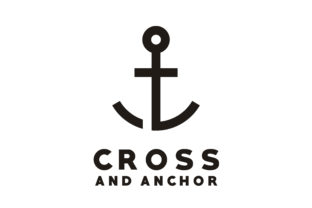
When these two symbols are combined, as in the Cross Anchor Christian Catholic Logo, they create a layered message: the cross is the source of that anchor-like hope. The logo visually declares that Christian hope is not wishful thinking but is secured by the historical and eternal work of Christ. The design often places the anchor at the base or integrated into the cross shaft, suggesting that the cross grounds and stabilizes the believer. Some variations show the cross emerging from the anchor’s ring or flukes, emphasizing the inseparable link between Christ’s sacrifice and the believer’s enduring confidence.
Why This Combination Speaks to a Broad Audience
For professionals designing church websites, educators teaching symbolism in religion classes, or business owners creating faith-based brand identities, the Cross Anchor Christian Catholic Logo offers a versatile visual reference. It communicates theological depth without requiring lengthy explanation. A parish might use it as a header logo, a confirmation class patch, or a watermark on digital bulletins. The anchor element appeals to maritime communities, coastal parishes, or any congregation that values the metaphor of navigating life’s waters with Christ as the anchor. The logo’s structure can be simplified or ornamented, making it adaptable for embroidery, stone carving, or screen displays.
Consumers searching for meaningful religious merchandise often gravitate toward items featuring the Cross Anchor Christian Catholic Logo because it embodies both identity and aspiration. It is not merely a brand mark but a statement of faith that is both personal and communal. Researchers studying religious iconography note that such hybrid symbols help modern believers connect with early Christian traditions while also speaking to contemporary visual culture. The anchor’s maritime associations also make the logo popular among Christian sailing groups, military chaplains, and retreat centers near water.
Historical Precedents and Modern Adaptations
The cross-anchor motif is not a recent invention. It appears in ancient Christian art, often in funerary contexts, where the anchor represented the hope of resurrection. Medieval manuscripts and ecclesiastical seals sometimes incorporated an anchor entwined with a cross. However, the explicit design known today as the Cross Anchor Christian Catholic Logo has been formalized in recent decades by various Catholic and Christian organizations seeking a distinct yet traditional emblem. Some dioceses have adopted it as an official symbol, while independent ministries use it in logos that require both cross and anchor imagery.
In modern application, the logo often incorporates additional elements such as a circle (representing eternity), a crown (victory), or a Celtic knot (continuity). The color palette may vary: traditional gold and navy for a classic look, or earth tones for a rustic feel. The typography paired with the logo should complement its gravity—serif fonts often work well for formal contexts, while clean sans-serif can suit contemporary digital platforms. The key is balance: the symbol must remain legible at small sizes (favicons, social media avatars) and impactful at large sizes (banners, stained glass).
Practical Considerations for Use
Anyone incorporating the Cross Anchor Christian Catholic Logo into their work should consider both legal and theological aspects. Many versions of the design are custom creations by artists or agencies; using a specific logo without permission may infringe copyright. However, the general concept (a cross combined with an anchor) is not trademarked as a universal symbol. For creators—whether graphic designers, hobbyists crafting church bulletins, or businesses producing religious goods—it is advisable to design original variations that respect the core symbolism while avoiding exact replication of an existing church’s logo.
Placement matters: the logo should not be trivialized by inappropriate contexts. For example, using it on a product that contradicts Christian teachings would be disrespectful. Conversely, when used in educational materials, the logo can serve as a discussion piece about the history of Christian symbols. Teachers and professors can use the logo to illustrate how visual metaphors evolve while retaining core meanings. Researchers might analyze its regional variations—Catholic versions sometimes include a papal cross or a chi-rho in the anchor’s ring, while Protestant interpretations may emphasize the empty cross and simple anchor lines.
Real-World Relevance Across Fields
For business owners, the Cross Anchor Christian Catholic Logo can be a distinctive branding element for a Christian bookstore, a religious retreat facility, or a faith-based counseling practice. It signals values of hope, stability, and redemption without being overtly commercial. Consumers often seek products that embody their beliefs, and a well-designed logo on a website or product package fosters trust and recognition. For creators—writers, musicians, artists—the logo can inspire visual projects that explore the intersection of faith and symbolism. A cover design for a book on hope, for instance, might feature the cross-anchor motif as a central image.
Hobbyists engaged in calligraphy, woodworking, or embroidery frequently recreate the Cross Anchor Christian Catholic Logo in their crafts. The design offers a satisfying challenge: the curves of the anchor and the straight lines of the cross require precision. Online communities share templates and tutorials, expanding the logo’s reach. Educators use it to teach about early Christian art—students can compare the catacomb anchor symbols with modern logos, analyzing how meaning is preserved or transformed. The logo thus serves as a bridge between ancient tradition and contemporary expression.
Placement in Digital and Physical Spaces
A church website might place the Cross Anchor Christian Catholic Logo in the header, evoking both welcome and reverence. When optimized as an SVG or high-resolution PNG, the logo retains clarity on mobile devices and high-DPI screens. For printed materials—bulletins, banners, prayer cards—the logo should be rendered in vector format to ensure crispness at any scale. Some congregations incorporate the logo into their official letterhead, projecting a cohesive visual identity that extends to social media profiles and promotional items.
The logo also appears in more permanent forms: carved into wooden lecterns, etched into glass doors, or woven into liturgical vestments. In these settings, the physicality of the symbol reinforces its message. A stone anchor with a cross cut into it, placed at the entrance of a church, silently communicates to every visitor: here is a place grounded in Christlike hope. The durability of the material echoes the steadfastness the anchor represents.
Considerations for Design and Interpretation
While the Cross Anchor Christian Catholic Logo is widely appreciated, it is not without nuance. Some viewers may be unfamiliar with the anchor’s biblical significance, mistaking it for a nautical symbol alone. Hence, contextual explanation—through a website’s “About” page, a sermon series, or a caption—helps deepen understanding. Designers should avoid overwhelming the logo with excessive ornamentation that obscures its clarity; the best versions are those that can be recognized at a glance. The cross must remain unmistakable, and the anchor’s form should be balanced, not cluttered.
From a theological perspective, the logo emphasizes hope grounded in sacrifice—a countercultural message in a world often seeking quick fixes. It invites reflection on the nature of Christian hope, which is not passive but active, anchored in a real historical event. This depth makes the logo suitable for use during Advent or Lent, seasons that highlight waiting and endurance. It also pairs well with scriptural passages such as Romans 15:13 or Psalm 62:5-8, which speak of hope and refuge.
Comparative Symbolism
Though the Cross Anchor Christian Catholic Logo is distinctive, it belongs to a family of hybrid Christian symbols: the cross and crown, the ichthys (fish), the chi-rho, and the triquetra all carry layers of meaning. The anchor’s advantage lies in its emotional resonance—it suggests safety, rest, and a point of reference in turbulent times. For a congregation located near a harbor, or for a ministry focused on grief and recovery, the logo can be particularly apt. It also appears in ecumenical contexts, as both Catholic and Protestant traditions have historically embraced the anchor symbol.
In a world saturated with logos and brands, the Cross Anchor Christian Catholic Logo stands out because it points beyond itself. It is not a mere visual identifier but a compressed creed. For the broad audience this article addresses—professionals, creators, educators, researchers, hobbyists, business owners—the logo offers a practical tool for communication and a rich subject for study. Whether applied in a digital design, a handcrafted gift, or a theological lecture, it carries a message that remains as relevant today as in the early Church: anchored in the cross, hopeful for eternity.